


Otium Den recap:
Britain needs muscular citizenship
AI vs The Industrial Revolution
Statist Singapore Builds. Statist Britain Plans.
The New York Times generously called the late Paul Ehrlich “premature”. But the biologist’s apocalyptic predictions about overpopulation were simply wrong.
Instead of Ehrlich’s suggested baby licenses, most advanced nations now actively encourage procreation as declining fertility rates leave fewer taxpayers to cover the costs of an ageing population. As the alternative quick-fix of immigration proves increasingly unpopular, pro-natalism is re-emerging as an alternative. But both the conservative and liberal guises of such policies, encouraging nuclear families and equalised parental duties respectively, have yielded little success. Chiefly, because they treat this as a recent phenomenon.
Ordo Amoris
In fact the fertility rate in England and Wales has been falling since the 19th Century and was already below replacement levels of 2.1 by the 1930s, when women in the workforce were rare and religiosity still pervasive. The post-war baby boomers were a brief correction to this trend.
That longer history correlates with the decline of community. Horizons grew beyond the small radius of one’s birthplace after the Industrial Revolution. And citizens took on direct relationships with the state rather than smaller localities. We do not have to idealise an earlier era, where infant mortality and absolute poverty were rife, to recognise this change inverted ordo amoris - the theological concept that JD Vance and Rory Stewart sparred over last year.
It describes the Christian idea that one’s obligations start locally and grow outwards. Family, then community, country, and so on. Stewart contested Vance’s view on biblical grounds but it is little different to the Burkean underpinnings of the conservatism Stewart once professed. It is Burke’s “little platoons”, the smaller organic associations that constitute a larger nation. Any hope of resuscitating birth rates must start here rather than relying on an abstract sense of duty to the nation or potential benefits from its purse.
Asia’s birth rate crisis
Asia demonstrates the futility of a centrally-led approach. Fertility rates in China, Japan, South Korea, Taiwan, Hong Kong and Singapore are some of the world’s lowest, hovering just above or below one. They are frantically rowing back on earlier Malthusian thinking. China officially abandoned its one child policy only a decade ago, and now levies additional tax on contraceptives in response to record-low births.
Singapore promoted a “Stop-at-Two” campaign in the 1970s. But in 2012, the government declared the evening of National Day to be National Night. Its promotional video included the lyrics:
I know you want it, so does the SDU… the birth rate ain’t going to spike itself.
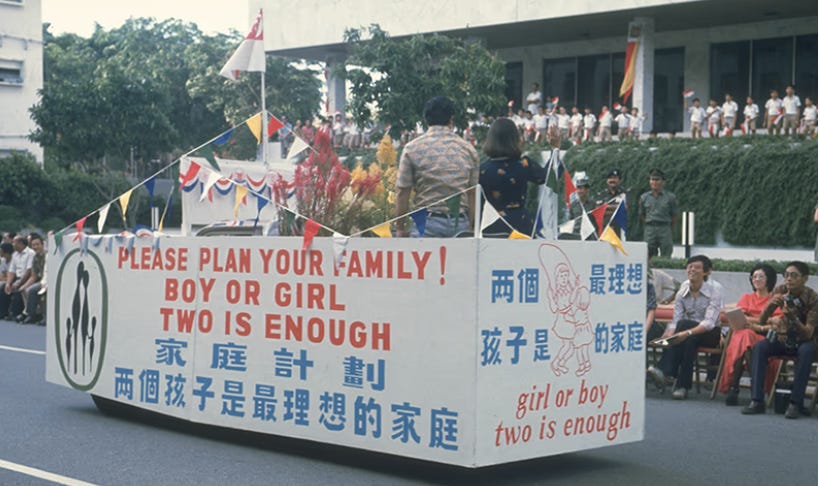
Asia challenges some of the myths conservative-minded thinkers cling to about fertility. Patriotism is not enough. All six countries record high levels of national pride and South Korea, Taiwan and Singapore enforce compulsory military service. Nor is a greater sense of familial obligation sufficient. Intergenerational living is far more common. Singapore even has a Maintenance of Parents Act that allows residents over 60 to claim allowances from their children, if they cannot support themselves.
Furthermore, the region’s ethnic homogeneity does not help. That seems to conflict with Professor David Solomon’s 2024 study of American women, which found those living in less racially diverse areas had more children. But that is a result of what the lack of diversity implies, rather than the uniformity in itself. It suggests continuity in the form of families living in the same place for a long time with few newcomers.
Compare that to China where the government’s own 2021 census records a “floating population” of 376 million. This means almost a third of the country lives outside of its registered internal origin under the hukou system. It does not matter that the vast majority of these migrants live among their ethnic counterparts. It matters that they are removed from their own communities. Perhaps a more pressing issue than condom prices.
State intrusion
Seeking better opportunities is a core conservative belief, echoed in Norman Tebbit’s on your bike aphorism. But in Britain, it’s too often a case of mobility for mobility’s sake. In 1960, five percent of 17-30 year olds were enrolled in higher education. By 2019, it had reached 50%, fulfilling Tony Blair’s 1999 target. Many of these new students leave their communities and incur a lot of debt without enhancing their life chances.
Alongside these arbitrary university targets, the state has also disrupted communities through regulation in the form of housebuilding and local bureaucracy. Baby boomers benefitted from the former through mass-building schemes in the 1930s. Today, regulation restricts supply, pricing out residents of increasingly affluent areas. Examples of the latter reside in the demise of the civic participation that marked the 1960s. DBS checks - an overreaction to the rare episodes of insidious exploitative figures - increase the burden on scouts or junior sports teams that once provided community childcare.
Unlike Asia, Britain follows its Western peers in looking to immigration as a solution to falling birth rates. But this compounds the hollowing out of its communities. Take Boston in Lincolnshire. Oxford University’s Migration Observatory records that its foreign-born population increased by 467% between 2001 and 2011. Policy Exchange calls it the least integrated place in Britain. In 2024, a Boston school was selected as one of five in a nationwide trial of AI-based translation technology, suggesting many pupils and their parents cannot speak English.
Boston was hardly a bastion of tranquility needlessly disrupted. It was already a post-agricultural market town losing its way. But patching up its economic listlessness with immigration just depletes an already lost community, instead of engaging with the harder problem of rejuvenation.
Why community matters
Families need a greater non-transactional security blanket. As the anthropologist Sarah Hrdy writes in Mothers and Others, “large-scale co-operative endeavours involving people who are not necessarily close kin,” has always been an essential part of raising children. But that social reciprocation depends on familiarity and trust. Qualities that reside in communities, not the state.
This does not mean harking back to some anachronistic rural idyll. Mobility, ambition and choice are good things. But the state tramples on the latter when housing regulation prices young families out of stable communities, university targets needlessly uproot a generation, bureaucracy strangles voluntary associations, and immigration further corrodes “left behind” towns. Destroying communities removes the agency of those who want to stay part of one.
Today’s pro-natalists only echo Paul Ehrlich’s mistaken belief that the government could and should control fertility rates. His analysis was as wrong as his prescription. Boosting fertility is a bottom-up endeavour. A thriving nation relies upon vigorous communities.